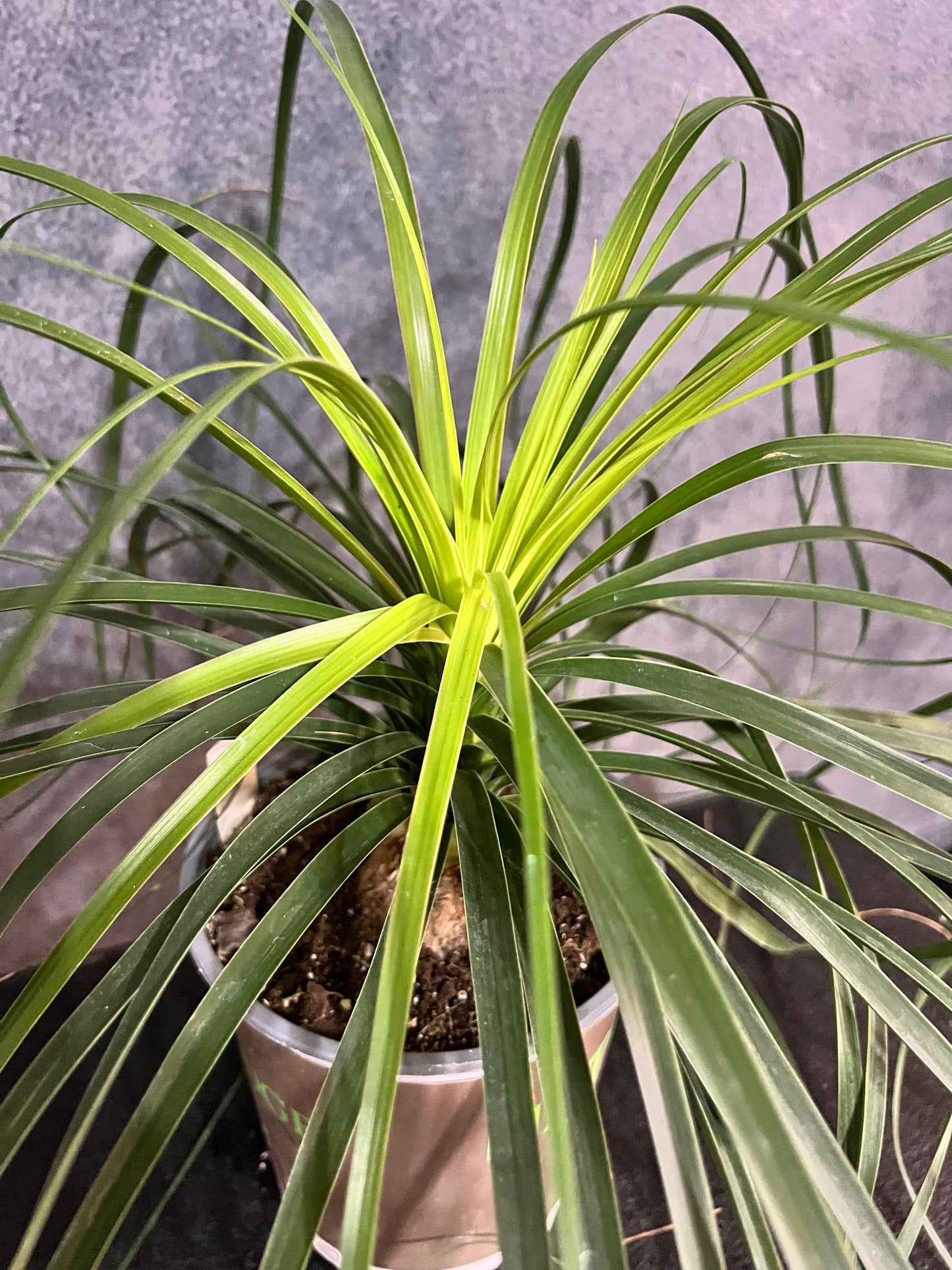

Ponytail Palm, Pony Tail Palm
Ponytail Palm, Pony Tail Palm
Plant name: Ponytail Palm
Scientific name: Beaucarnea recurvata
Plant description:
Ponytail Palm is a long-lived, architectural succulent known for its swollen, bulb-like trunk and cascading foliage. Despite its common name, it is not a true palm but a member of the Asparagaceae family. The enlarged base, known as a caudex, stores water and gives the plant its distinctive sculptural form. It is widely grown as a houseplant and as a landscape specimen in warm climates due to its drought tolerance and low maintenance requirements.
Flower description:
Mature outdoor plants may produce large, branching panicles of small, creamy white flowers. Blooming typically occurs on older, established plants and is rare in indoor specimens. The flowers rise above the foliage and are followed by small seed capsules.
Leaf description:
Leaves are long, narrow, and strap-like with a graceful arching habit. The foliage emerges in a fountain shape from the top of the trunk, often reaching several feet in length. Leaves are medium to dark green and have a slightly rough texture along the edges.
Deciduous or evergreen:
Evergreen
USDA grow zones:
USDA Zones 9–11 outdoors; commonly grown as a container plant in cooler climates
Mature height and width:
Outdoors, it can reach 10–20 feet tall with a spread of 6–10 feet over time. In containers, it typically remains 3–6 feet tall and proportionally narrower, depending on pot Size and age.
Landscape uses:
Used as a specimen plant in xeriscape gardens, rock gardens, and modern landscape designs. Popular as an indoor statement plant for homes and offices due to its sculptural trunk and minimal watering needs. Performs well in containers, patios, and bright interior spaces.
Native range:
Eastern Mexico
Sun exposure:
Full sun to bright indirect light. Indoors, place near a south- or west-facing window for best growth. In outdoor landscapes, full sun promotes sturdy growth and compact form.
Water requirements:
Low water needs. Allow soil to dry thoroughly between waterings. Overwatering is the most common cause of decline. Use a fast-draining soil mix, especially in containers. Reduce watering frequency in winter.
Pests and problems:
Generally pest resistant but may occasionally develop spider mites, mealybugs, or scale in indoor conditions. Root rot can occur in poorly drained soil or with excessive watering. Brown leaf tips may develop from inconsistent watering or low humidity indoors.
Heat and sun tolerance:
Highly tolerant of heat and intense sun when acclimated properly. Performs well in dry, hot climates due to its water-storing trunk.
Cold tolerance:
Cold sensitive. Can tolerate brief temperature drops to the mid-20s°F once established, but prolonged freezing can damage or kill the plant. Container plants should be protected from frost and freezing conditions.
Growing tips:
Plant in a well-drained container with drainage holes and a gritty, cactus-style soil mix. Avoid overSized pots, as excess soil retains moisture and increases the risk of root rot. Rotate indoor plants periodically to encourage even growth. Remove dead or damaged leaves at the base to maintain a clean appearance. Fertilize lightly during the growing season with a balanced, diluted fertilizer to support steady growth without excessive foliage.
---SHIPPING NOTICE PLEASE READ BEFORE PURCHASING LIVE PLANTS!---
We WILL NOT refund the purchase of or the shipping cost of live plants purchased with the intent to be shipped to states that do not authorize importing live plants or to states with restrictions! Purchases to these states will be held for 30 days for pick-up at our Slidell, Louisiana store and the shipping cost associated with these purchases will be held for the care of the plant while waiting to be picked up. All sales are final. If the plant(s) purchased are not picked up within 30 days from the date of order, these items will be returned to our sales inventory and you WILL NOT be refunded. Thank you for understanding these policies.
Due to regulations, certain states have restrictions on importing plants. Please review the list below to ensure you're not attempting to order any restricted plants in your area.
**Important Note:** We do not ship any plants outside the U.S.
State-Specific Restrictions - We ARE NOT responsible for any plant(s) that are not listed in these restrictions. Purchaser bears all responsibility for making sure the plant(s) they desire to purchase are not banned from being imported to the shipping state:
Arizona: Juglans spp.
California: Castanea spp., Juglans spp., Pinus spp., Quercus spp.
Colorado: Some counties restrict Prunus spp. Please verify your local county regulations.
Florida: Castanea spp., Cornus spp., Quercus spp., Cornus mas
Georgia: Vaccinium spp.
Hawaii: Pinus spp.
Idaho: Humulus lupulus, Mentha spp., Vitis spp.
Indiana: Fragraria spp., Rosa spp.
Kansas: Juglans spp.
Michigan: Abies spp., Vaccinium spp.
Montana: Pinus spp.
Nevada: Allium spp.
, Mentha spp.
New Jersey: Rosa spp.
New York: Vitis spp.
Oregon: Allium spp., Castanea spp., Corylus spp., Humulus lupulus, Quercus spp., Sambucus nigra, Ulmus spp., Vaccinium spp., Vitis spp.
Texas: Juglans spp.
Washington: Allium spp., Castanea spp., Corylus spp., Humulus lupulus, Vaccinium spp., Vitis spp.
Wisconsin: Abies spp., Pinus spp., Picea spp., Mentha spp.
Additionally, we cannot ship plants in soil medium to the following states: AK, AL, AR, AZ, CA, HI, ID, KS, MS, MT, ND, NM, NV, OK, OR, SD, TX, UT, WA.
Couldn't load pickup availability