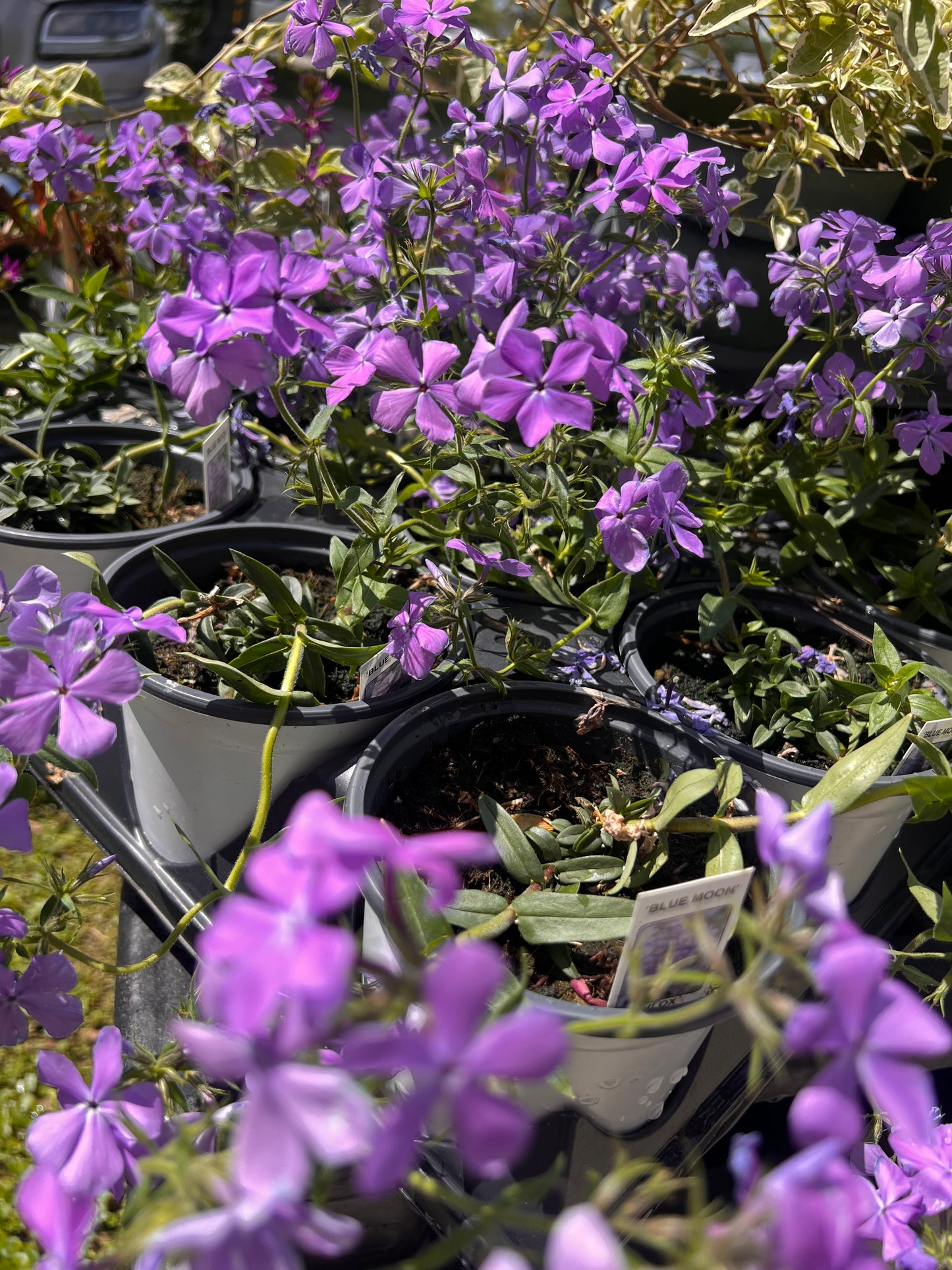

Phlox Blue Moon
Phlox Blue Moon
Plant name: Phlox ‘Blue Moon’
Scientific name: Phlox divaricata ‘Blue Moon’
Plant description:
Phlox ‘Blue Moon’ is a woodland perennial selected for its large, fragrant blue-violet flowers and improved garden performance. This low-growing, spreading phlox forms a soft mat of foliage that fills in beneath trees and along shaded borders. It is valued for its spring bloom display and ability to naturalize in suitable conditions.
Flower description:
Clusters of five-petaled flowers appear in mid to late spring, held just above the foliage on slender stems. Blooms are a clear lavender-blue to soft violet and release a light fragrance. The flowers attract butterflies and early-season pollinators.
Leaf description:
Leaves are narrow, lance-shaped, and medium green with a soft texture. Foliage forms a low, spreading groundcover that remains attractive after flowering.
Deciduous or evergreen:
Herbaceous perennial; deciduous in winter.
USDA grow zones:
Zones 3–8.
Mature height and width:
8–12 Inches tall in bloom and 12–18 Inches wide, spreading gradually over time.
Landscape uses:
Suitable for woodland gardens, shaded borders, underplanting beneath shrubs, and naturalized areas. Effective as a spring groundcover and in pollinator-friendly landscapes. Performs well along pathways and in front-of-border plantings.
Native range:
The species Phlox divaricata is native to eastern North America. ‘Blue Moon’ is a cultivated selection.
Sun exposure:
Partial shade to full shade is preferred. Tolerates morning sun, especially in cooler climates. Too much intense afternoon sun may stress the plant.
Water requirements:
Prefers evenly moist, well-drained soil rich in organic matter. Water regularly during dry periods, particularly during establishment and bloom time. Avoid prolonged drought conditions.
Pests and problems:
Generally low maintenance. Powdery mildew may occur in humid conditions with poor air circulation. Occasional issues with spider mites or foliar diseases may appear under stress. Proper spacing improves airflow.
Heat and sun tolerance:
Performs best in moderate temperatures and dappled light. High heat combined with strong sun can reduce vigor. Consistent soil moisture helps maintain healthy growth during warmer periods.
Cold tolerance:
Hardy within its recommended zones. Top growth dies back in winter, with roots surviving freezing temperatures typical of Zones 3–8.
Growing tips:
Incorporate compost into the planting area to improve soil structure and moisture retention. Space plants to allow airflow and reduce disease risk. After flowering, lightly trim to maintain shape and encourage dense growth. Divide established clumps every few years to maintain vigor and expand plantings. Provide consistent moisture during active growth for best bloom performance.
---SHIPPING NOTICE PLEASE READ BEFORE PURCHASING LIVE PLANTS!---
We WILL NOT refund the purchase of or the shipping cost of live plants purchased with the intent to be shipped to states that do not authorize importing live plants or to states with restrictions! Purchases to these states will be held for 30 days for pick-up at our Slidell, Louisiana store and the shipping cost associated with these purchases will be held for the care of the plant while waiting to be picked up. All sales are final. If the plant(s) purchased are not picked up within 30 days from the date of order, these items will be returned to our sales inventory and you WILL NOT be refunded. Thank you for understanding these policies.
Due to regulations, certain states have restrictions on importing plants. Please review the list below to ensure you're not attempting to order any restricted plants in your area.
**Important Note:** We do not ship any plants outside the U.S.
State-Specific Restrictions - We ARE NOT responsible for any plant(s) that are not listed in these restrictions. Purchaser bears all responsibility for making sure the plant(s) they desire to purchase are not banned from being imported to the shipping state:
Arizona: Juglans spp.
California: Castanea spp., Juglans spp., Pinus spp., Quercus spp.
Colorado: Some counties restrict Prunus spp. Please verify your local county regulations.
Florida: Castanea spp., Cornus spp., Quercus spp., Cornus mas
Georgia: Vaccinium spp.
Hawaii: Pinus spp.
Idaho: Humulus lupulus, Mentha spp., Vitis spp.
Indiana: Fragraria spp., Rosa spp.
Kansas: Juglans spp.
Michigan: Abies spp., Vaccinium spp.
Montana: Pinus spp.
Nevada: Allium spp.
Mentha spp.
New Jersey: Rosa spp.
New York: Vitis spp.
Oregon: Allium spp., Castanea spp., Corylus spp., Humulus lupulus, Quercus spp., Sambucus nigra, Ulmus spp., Vaccinium spp., Vitis spp.
Texas: Juglans spp.
Washington: Allium spp., Castanea spp., Corylus spp., Humulus lupulus, Vaccinium spp., Vitis spp.
Wisconsin: Abies spp., Pinus spp., Picea spp., Mentha spp.
Additionally, we cannot ship plants in soil medium to the following states: AK, AL, AR, AZ, CA, HI, ID, KS, MS, MT, ND, NM, NV, OK, OR, SD, TX, UT, WA.
Couldn't load pickup availability